Showing posts with label Spring work. Show all posts

Wednesday, April 20, 2011

Ready, set, go! Spring work is beginning!

Remember what it was like to wait for Christmas to open presents and thinking that day would NEVER come??! Well, its been a little like that around here waiting for Spring to arrive and some mornings it has even looked a little like Christmas with snow on the ground. This Spring has been an exercise in patience and knowing that one day soon, it will be time to finally get in the fields....and today was that day! So with a big smile and packing his lunchbox, Farmer Joe got to go outside and play on his tractor. 

The video explains what the farmer got to do today, and he was a very happy camper.


Just like preparing your garden for the new growing season, we need to prepare our fields and rid them of the weeds.
  

GPS receiver and display unit.
The above GPS receiver shows the field that is in the process of being sprayed and the yellow color is where the farmer has been and the green part shows what is left to spray.  That way we don't overlap the same area and it helps keep our cost down as well as not using more product than necessary.  Another example of being "sustainable in our day-to-day" work.

The mixing cone holds the bulk glyphosate (generic Roundup) before being
inducted into the spray solution

Another view of the mixing tank  being filled

Rear view of the sprayer from the back of the cab
 As always, thanks for stopping in to read the blog and if you have questions, please feel free to email me at idahofarmwife@gmail.com .  Stay tuned for more farm adventures as this is just the beginning. =)

Saturday, May 15, 2010

Helping the Neighbor


Shown above is Joe in his tractor on a side hill.   The recent rainy weeks have kept many of the other farmers out of their fields.  While we finished seeding before the rain, many did not and it's critical in getting the crops in the fields.  So Joe is helping out a neighbor to get his soft white wheat in the field. 
This is what a freshly seeded field looks like when you plant it with a special "no till drill"implement.  Notice the wheat straw from last years harvest, the wheat stubble will help catch rain water as well help reduce erosion  when it does rain and the stubble also helps keep moisture in the ground for the crops (think of using compost material in your gardens to reduce weeds and lock in moisture) but only a much larger scale.  Plus by not plowing in the fall and by seeding directly into last year's stubble, it saves fossil fuel and is better for the soil health. 

Monday, April 5, 2010

Springwork Temporarily Interupted by Snow


Weather on the Palouse is a fickle thing, especially in Spring.  So with that being said, we are patiently waiting for drier, nicer weather in hopes that we can get back in the fields again.  The spring wheat  has been planted on the Tammany farm, we moved up to the Genesee farm and were able to get some more wheat planted, but have more to go.  We also have garbanzo beans to get seeded on both farms and those plants need much warmer weather to germinate, so I'm thinking warm spring, warm sunny weather thoughts (so is our granddaughter pictured above).  We are probably about 40% done, so we're not panicking about being out of the fields right now due to weather related conditions and will hope the ground will dry out enough very soon. =)

Monday, March 1, 2010

Spring is coming....

Driving home today after work, it was 57 degrees, very rare for the 1st day of March (at least around here). I could hardly contain myself and wanted to be outdoors, knowing with it being so warm that I would be able to smell the dirt. The fresh earth smell is a wonderful smell unlike anything else and I have always loved the smell of dirt even as a child.

So with our recent lack of snow this past winter, Spring work for us is here. Joe was down at our Tammany farm which is about an hour away from our Genesee farm and sprayed about 150 acres of Roundup which kills weeds and/or volunteer sprouts from the previous crops. They do this in preparation to plant the new spring crop, which in that particular area will be spring wheat. Joe took this short video with his camera phone last week while driving the 4 wheeler behind the dry fertilizer truck which was topdressing the winter wheat (which is planted in the Fall of 2009).

Saturday, February 6, 2010

Life on the Farm, February 6, 2010

As my husband, Joe and I were driving to Pullman today around 3pm, the sun was out and it was truly feeling like an early Spring day. You could see a glimmer of green in the fields, which are the little blades of winter wheat peeking out of the ground. I think it is going to be an early spring for us as we have not gotten any snow, the temps are in the 40s and it is expected to stay that way throughout February.

This picture (above) is from spring work last year. The silver tanks on the tractor and the small silver container at the very end are ammonia, which is nitrogen fertilizer. The implement right behind the tractor contains a dry blend of phosphate, nitrogen & sulfur in one of the yellow tanks and seed in the other yellow tank.

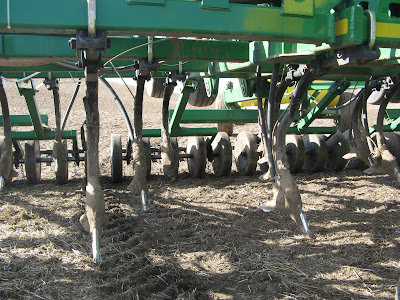
The next implement is the tool that puts the dry fertilizer and seed into the ground. In this picture (below) it shows the part of the machine called "openers" that go into the ground (to plant the seeds along with the fertilizer). I'll make short video clips that will explain this process more, so keep watching.

The reason Joe and I were heading to Pullman is that we were invited for dinner with one other farmer couple to enjoy a casual dinner with our friends who also are part owners of chemical company whom we do business with. Dinner and conversation was great and it was fun to get to know the other couple.
As I had mentioned before in other blogs, the winter season is a time for farmers to attend meetings and the day before, Joe had attended a continuing education meeting hosted by a few chemical companies that were promoting their newest products. In these meetings, they often will serve as way to help educate the farmers in the proper application of chemicals. Many farmers hold certifications to apply certain herbicides on the crops and must maintain current educational credits to keep their license.