Tuesday, February 16, 2010

Fun Event for the Farmers

Joe and I were hosts this past Valentines week-end to friends who were the successful biders of a snowmobiling week-end package which was a fund raiser for the Idaho Grain Producers. I was excited to find that we actually knew the winners, Matt and Kathy, who farm down in Southern Idaho.


Below is Joe & Matt resting after one of their wild rides. What can I say about men and their toys! =)


On Saturday, we took Matt and Kathy to our annual Genesee Fireman's Crab Feed which is a local fundraiser for our volunteer ambulance/fireman. Our little farming community consists of about 1,000 people and our ambulance/fireman service is staffed entirely of volunteers. Joe was an EMT with the department the first 18 years of our marriage and we worked this event during all of those years. Now that he retired from the volunteer dept, we get to be guests instead of working it. Matt and Kathy are the crazy ones beside my husband. Our little granddaughter found us in the crowd and was giving grandma loves and hugs! =)


Here is Kathy and me taking a break. I had not been on a snowmobile for probably 25 years.... I'm a little sore all over. This was such a fun week-end and we enjoyed every minute of it.

Monday, February 15, 2010

Please don't mind the mess....

If this blog looks weird it is because I am in the process of moving it to a different private domain. So the end results should be better features and easier navagation . So for now, please keep reading at this site until it I get it re-directed. Thanks! =)

Saturday, February 6, 2010

Life on the Farm, February 6, 2010

As my husband, Joe and I were driving to Pullman today around 3pm, the sun was out and it was truly feeling like an early Spring day. You could see a glimmer of green in the fields, which are the little blades of winter wheat peeking out of the ground. I think it is going to be an early spring for us as we have not gotten any snow, the temps are in the 40s and it is expected to stay that way throughout February.

This picture (above) is from spring work last year. The silver tanks on the tractor and the small silver container at the very end are ammonia, which is nitrogen fertilizer. The implement right behind the tractor contains a dry blend of phosphate, nitrogen & sulfur in one of the yellow tanks and seed in the other yellow tank.

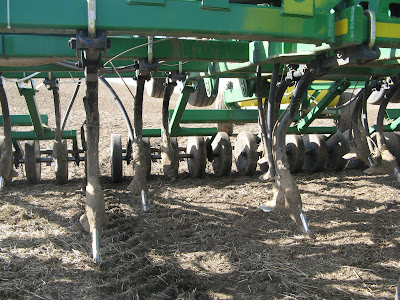
The next implement is the tool that puts the dry fertilizer and seed into the ground. In this picture (below) it shows the part of the machine called "openers" that go into the ground (to plant the seeds along with the fertilizer). I'll make short video clips that will explain this process more, so keep watching.

The reason Joe and I were heading to Pullman is that we were invited for dinner with one other farmer couple to enjoy a casual dinner with our friends who also are part owners of chemical company whom we do business with. Dinner and conversation was great and it was fun to get to know the other couple.
As I had mentioned before in other blogs, the winter season is a time for farmers to attend meetings and the day before, Joe had attended a continuing education meeting hosted by a few chemical companies that were promoting their newest products. In these meetings, they often will serve as way to help educate the farmers in the proper application of chemicals. Many farmers hold certifications to apply certain herbicides on the crops and must maintain current educational credits to keep their license.

Tuesday, February 2, 2010

Equipment used on the farm

 SDC10313

While trying to give my blog a more interesting look, I came across this picture of my husband and his combine during harvest last year.  I’ve been searching for farming backgrounds to update my blog and can’t find anything out there.  So I’ll be brave and see if I can edit the free template I downloaded…. stayed tuned.   It’s sort of like a bad hair cut, you will eventually get what you want but it takes a few ugly times before you get the look you like.

Sunday, January 31, 2010

The Farmer Perspective Part II

As farmers, we get our "industry trade news and/or journals" that relate specially to farming and ranching of which keeps us up-to-date on Ag current events. One of the publications we read is called the Capital Press and within it contained articles on Michael Pollan's visit to Washington State University (WSU), of which I also attended. The Pollan presentation was advocating a return to a diversified agricultural system to once again begin harnessing the sun to feed ourselves and wean ourselves off of the fossil fuel diet, thus the title "The Sun Agenda". He is referring to the oil and natural gas required to make fertilizer, fuel and pesticides. This was based off of the premise that today's food chain closely resembles a factory model from which most of us get our food. Before WWII, the food system was ecologically efficient advised Mr. Pollan and it generated 2 calories of food energy for every 1 calorie of fossil fuel energy that went into it. Now, he said agriculture produces 1 calorie of food for every 10 calories of fossil fuel it uses. He alleges this stuff, but where is the actual proof this is acurate? He can say all sorts of things and not really have to back up his facts with proof...... In his talk, he spoke of a rancher who had 100 acres of ground, grazed his cattle within sectioned off fields, then after a period of time moved the cows to a different field to graze. Then in the recently grazed field the rancher would turn out chickens to eat the maggots from the cow pies, who would also spread out the cow pies, plus leave their own droppings in the field and thus helping fertilize the ground. Then after a length of time, the cows would return to the 1st nice green fertilized field and the process was started all over again. It was the perfect "ecological balance of man, nature and food" according to Michael Pollan. While this was very interesting, it is not a practical solution to feeding the entire USA, not to mention the rest of the world. Farmers are not against new ways of doing things, it is just that we are charged with the duty to effectively produce better and higher yielding crops off of the same acreage and do this all while trying to make a living. At a prior event to the Pollan lecture, there was a poster that said, " A hungry man does not see right from wrong, he only sees hunger". I want to re-emphasise that farmers are good stewards of their land, why would we abuse the ground that is our livelihood? We live here, we raise our families here, we feed ourselves and the world with what we produce, so why is it that people like Michael Pollan feel the need to tell us that we are doing it wrong? It is reported that Micahel Pollan receives between $20,000 -$45,000 per lecture. Apparently this is how he makes his living by observing from afar how we should be farming or ranching and then charging a speaker fee that perhaps is a yearly wage to some. Interesting.

Mr. Pollan noted that the average family spent 24% of it's income on food in 1910, 18% was spent on food in 1960 and just 10% of our income was spent on food in 2009. " In his observation, as food got cheaper to produce, it become more loaded with calories and it was also processed into less healthful forms of food. As a result, 2/3 of the US population is overweight and 1/3 is obese, and a recent Emory University study predicts more than half of all American will be obese within 10 years." Excuse me, but why is the American farmer being vilified for making people fat? Americans demand, and I might add receive top quality food at affordable prices, so I would think that the average person makes their own shopping decisions while at the grocery store on what they put into their basket and on their dinner table. While one of the things that Pollan did advocate and I do too, is that people should eat the foods that their great grandmothers would recognize. He also advocated planting a garden and cooking healthier things. I agree on that, but I cannot tell someone what to buy or eat, that is their choice. So consumers have the power to change what is available in stores, not farmers.

Wednesday, January 27, 2010

Winter on the Farm, January 2010


Winter on our farm is a fairly relaxed time as we do not have livestock. As I've mentioned before in past blogs, this is a time when the tractors, trucks and combines are in for routine maintenance to try to ensure that all the equipment runs smoothly during the hectic times. Winter is also is the time of year best suited to our industry when we can attend meetings/seminars as this is our down time.

This winter my husband has been traveling quite a bit to attend the Idaho Grain Producer Assoc (IGPA) meetings as well as the National Association of Wheat Growers (NAWG). The men and women elected to their boards give their time, talent and energy to focus on upcoming issues/legislation that will affect our industry.

Last month Joe was called to Denver to help select the new CEO for NAWG. It was exciting to hear the news that the new CEO is a woman named Dana Peterson. I'm hoping to get a chance to meet her when I travel with Joe to the national NAWG meeting in March.

AS for the home scene on the farm : I read the voting results on what people want to see in the blog, so to comply, I'm going to start video taping things that are going on at the farm beginning with our Spring work. So stayed tuned! Also people have commented to me that they love the recipe section and my activities too. So I'll keep posting recipes and report on my adventures. Check out the "app" on my blog called "How to Cook Anything", you simply put a couple of ingredients that you want to cook and it lists recipes to choose from. I tried it myself last night and made Lemon Spaghetti. It was really good. So to my recipe foodies, I'll post more specific blogs that focus solely on food.
Thanks for reading it, and please feel free to ask questions. =)

Flour School, Differences in Flour

Opening this mornings paper, there lo and behold were recipes on pizza, then I started reading my new Sunset magazine and it had a whole section on pizza and chocolate (my 2 favorite food
groups). So I thought I would address what the difference is between bleached and unbleached flour as it can make a difference in the results of your baking adventures.
Bleached Flour has a slightly lower protein content than unbleached flour because of the chlorination process it goes through. Protein develops into gluten, which provides structure in baked goods. Less protein in bleached flour means less gluten and a softer, lighter texture and finer grain, just the qualities you want in more delicate pastries like cakes, pastry dough, muffins and shortcakes.
Unbleached Flour is better for sturdier baked goods, like yeast breads or pizza dough. Its higher protein content allows the yeast to rise and still support the structure of the dough.

Now to get even more technical about some of the wheat we grow on our farm. Each class of wheat has its own characteristics and are used by the buyers as such:
Soft White Wheat (winter & spring wheat) - mainly used for pastries, pancakes, cakes, cookies, crackers, flat breads, snack foods and cereals.
Hard Red Wheat (winter & spring) yeast breads, hard rolls, bagels, Asian noodles, flat breads
Hard White Wheat (winter & spring) blended flours, Asian noodles, steam breads, domestic foods made with whole wheat
Durum: pasta

Idaho wheat production is usually between 85-95 million bushels/year. Wheat production plays an important role in the Idaho economy. The value of production in 2008 was $646 million.

I will try the recipes listed in the paper and the magazine, but for now, here is my personal favorite pizza recipe and a yummy chocolate recipe to round out the meal.
Pizza Dough
Combine in a mixing bowl
1 cup warm water
1/2 teas salt
1 Tbl olive oil
1 teas sugar
1 pkg yeast or 2 1/2 teas yeast (if you buy in bulk)
Once the yeast is bubbly, then add:
2 cups unbleached flour
1/4 cup cornmeal
Then add 1/2 -3/4 cup more flour to make a firm dough.
Let rise to double, punch down and prepare as you normally would. My personal favorite is brush the pizza stone with a mixture of olive oil and about 2 teas of minced garlic, then spread the dough out on the stone. Then add more olive oil and garlic ( 2-3 Tbl of olive oil and 1-2 teas minced garlic) just enough to cover all the dough. Then add your favorite toppings and add mozzarella cheese. I like to bake mine on the convection setting of 425 for 17 minutes.

++++++++++++++++++++++++++++++++++++++++++++++++++++++++++++
Chocolate Shortbread Cookies
1/2 cup softened butter (no substitutions)
3/4 cup bleached flour
3/4 cup confectioners' sugar
3 Tbls unsweetened cocoa powder

Preheat oven to 300 degrees. With electric mixer, beat butter until creamy, add flour, sugar and cocoa until combined. If dough is too soft to handle, chill in refrigerator 10 min). Pat dough into an 8 in round greased cake pan, press edges down with the tines of a fork. Bake until firm, about 30 min. Immediately score into 8 sections and cool completely. Turn out of the pan and break wedges apart.

Wednesday, January 20, 2010

The Farmer Perspective, Part I

As promised, I said I would start blogging about my recent experience seeing Michael Pollan's presentation called "The Sun Food Agenda". The speaker had expressed many points regarding agriculture, it's production both in crops and animal harvest, and his views of how things should be done by those of us who farm and ranch. Although he did have some interesting points of view, some of which I agreed with and some I didn't, it was interesting to have someone who has never farmed, tell us how he thought we should conduct our business.

One of the things that he was talking about was the farm wife needing to work off the farm to keep medical benefits for her family. The speaker felt that it was detrimental to the farm that the women had to work off the farm to keep medical benefits for her family. This I agree with as I have always had to work off the farm and been the one to keep our family covered with medical insurance. Although each family's situation is unique, ultimately each family must do what they need to do. As for me,the positions that I held were full time and it was not an option to make them part time or job share, so I always worked full time and juggled family, farm and work duties. One of my first blogs was about taking 2 weeks off during wheat harvest to drive truck. Only in the past year or so have I had the opportunity to work part time off the farm and yet still maintain medical benefits for our family. From my perspective, it is the wife/mom that is the glue to keep the farm and family running smoothly. We are the ones often doing the behind the scenes kind of things to keep operations running smoothly.

One of the things that the speaker stressed was eating together, preparing foods that your great grandmother would prepare (cooking at home from scratch) and having a garden. All of these, I heartily agree with and if you think about it, food is an important part of our lives. We associate food with holiday or special celebrations. I could go on and on about this subject, so let's just say I agree with his views. I can say our family always ate dinner together, we didn't go out to dinner often, and I cooked from scratch. With a little bit of organization it was not hard and was a good basis for our daughters growing up. I do not like fussy food and usually stick to basics, plus I like to make things from scratch. Here are some new favorites:

Mac n Cheese (this is very upscale and tasty - not what your mom would have made)
8 Tbl butter, plus more for casserole
6 slices good white bread, crust removed, torn into 1/4inch pieces ( You can substitute fine bread crumbs, -about 1 cup)
5 1/2 cups milk
1/2 cup flour
2 teas salt
1/4 tsp nutmeg
1/4 tsp black pepper
1/4 tsp cayenne pepper
4 1/2 cups (about 18 oz ) grated sharp white cheddar cheese
1 1/4 cups (about 5 oz) grated Pecorino Romano cheese
1 lb or about 2 cups of macaroni (cooked per instructions but slightly underdone)

1) Preheat oven to 375. Butter a 3 quart casserole dish, set aside. Place bread crumbs in medium bowl and pour 2 Tbl of melted butter over bread, toss well. (same method with fine bread crumbs)
Set aside.

2)Warm milk in microwave or saucepan. Melt remaining butter in high sided pan over medium heat, when butter bubbles, add flour, whisking till combined, about 30 seconds.

3)While whisking, add hot milk a little at a time, whisk so mixture is smooth. Continue to cook till mixture thickens and bubbles, about 8-12 min.

4) Remove from heat, stir in salt, peppers, nutmeg, 3 cups of white cheddar cheese and 1 cup of Romano cheese. Set the remaining cheeses aside.

5) Add cooked macaroni to cheese mixture and pour into prepared casserole dish, top with
remaining cheeses and bread crumbs. Bake uncovered until golden, about 30 minutes. Let sit 5 min, then serve and enjoy.

++++++++++++++++++++++++++++++++++++++++++++++

Butternut Squash Bake

1 butternut squash, cut in half, seeded

1/2 cup mayonnaise
1/2 cup finely chopped onion or 2 TBl dried onion
1 egg
1 teas sugar
salt/pepper to taste
Mix this in a bowl till well blended.

1/4 cup crushed saltines (about 8 crackers)
2 Tbl grated Parmesan cheese
1 Tbl melted butter
Mix this in a separate bowl.

Preheat oven 350, place halved squash on a cookie sheet, cut side down and bake about 20-25 min. Once the squash is cool enough to handle, scoop out pulp leaving a shell. Add cooked squash to mayo mixture. Then evenly add the mixture back into the empty shells, place back on the cookie sheet and sprinkle the cracker mixture over the squash. Bake for 30-35 minutes until top is golden brown.

Happy cooking and enjoy.

As for gardening, well..... let's just say it is a good thing Joe is a better farmer than I am as a gardner! (Basically I'm a crappy gardner, but I'm trying) I'll tell you about my gardening adventures some other time.

Also, thank you for reading my blog. Please email me if you ever any questions about farm life or recipes. I will try to quickly respond and I'm happy to chat with you.

Wednesday, January 13, 2010

Feeding the World in the 21st Century

On 1/13/2010, I attended a seminar titled "How willl we feed the world in the 21st Century?" put on through Washington State University (also where I work). One of the presenters is a friend of ours, Russ Zenner. Russ and his wife, Kathy, were one of our farm host guests from our Dinner on the Farm series. There I saw two of our former Dinner on the Farm guests, Kenna Eaton and Carol Spurling both from the Moscow Food Co-op. The guest speakers were comprised of a cattleman who represented the cattle industry, our friend Russ who represented the farming industry, a WSU professor involved in the College of AG and a woman from the Seattle area who represented the largest Food Co-op in the U.S. The audience was able to ask questions of the panelists and it was a good medium in which to be able to share opinions, views and information from each of their perspectives. The audience was made up of students, staff and community members. Kenna, who is the manager of the Moscow Food Co-op commented to me after the event that it was very much
like our Dinner on the Farm event, only on a much larger scale. After this event, a group of us Genesee farmers went on to hear Michael Pollan who is the author of "The Omnivore's Dilemma". I'll blog about this next, so to not have this one so long. Plus Mr. Pollan gave me so many more blogs to talk about, so either stay tuned or watch out! =)

On my way home, I was reflecting that those of us in the Ag industry love what we do. It is our passion and mediocrity in our industry is not accepted. Many of us come into farming either by marriage or being born into farming families, but either way, those that stay in this industry have a true passion for it. I saw something called the "Passion Equation" and the formula was simple: Interest + Information = Passion. In order to continue to be profitable within the Ag industry, farmers must be on the continual hunt for ways to do things better, more efficient as well as cost effective so that is where the "information" part of this equation comes into play. What other industry gets so much scrutiny as well as restrictions imposed by people who most likely have never set foot on a farm and have to defend our industry to hostile environmental groups? So yes, we love what we do and are committed to feeding America, as well as the world, with a high quality as well as safe product.

Wednesday, January 6, 2010

Social Networking & Staying Connected

As I was driving into work today, I was mentally checking off the things I needed to accomplish like updating the WSU's website, posting upcoming meetings on Twitter, getting internal communications out, so on and so forth. It made me think about how social networking is also helping the Ag industry communicate with those who are not involved in farming or ranching, but have an interest. Facebook, Twitter or blogs are excellent ways for us to "tell our story" and put a face on the family farms. I have had people come up and say how much they enjoyed my blog and found it informative when I write about what we are doing on the farm. A couple days ago I ran into one of our guests from our "Dinner on the Farm" series (which I've blogged about too) and she told me that she and husband still talk about their fun evening; plus she is a follower on my blog. Having non Ag people read my blog is one thing, but I have to admit, I was a little intimated when my husband told me my blog had been sent out to the Idaho Grain Producers board members… I thought, will they find it interesting? But then I realized that Ag people are interested in what other Ag people do, we like to stay connected to our fellow colleagues. In fact Marcie Williams, Past President of American Agri Women had emailed me to relate her own humorous "dog cookie" story (i.e. my 12.23.09 blog) so I guess I'll just keep on writing about random topics on farming, our life and whatever pops into in my crazy little brain. But I also welcome suggestions too! =)

To my recipe junkies: Tonight I'll post another yummy recipe called Apple Pie Bread... yummm. Well, my break time is done, off to the murky depths of the website.

Updating the blog @ 7pm

APPLE PIE BREAD

1/2 cup butter, softened
1 cup sugar
1/4 cup buttermilk or sour milk
2 teas baking powder
2 eggs
1 teas vanilla
2 cups flour
1/2 tsp salt
2 cups shredded, pealed apples (about 4 medium)
1 cup chopped walnuts or pecans

Streusel nut topping

Preheat oven 350, grease 9/5/3 inch loaf pan. Set aside.
In a bowl, beat butter for 30 seconds, then add in sugar till combined. Add buttermilk, baking powder, eggs & vanilla, mix well. Add flour, salt, mix well. Stir in apples and nuts.

Spoon in batter into loaf pan, spread evenly, then sprinkle STREUSEL NUT TOPPING: in a small bowl combine 1/4 cup brown sugar, 3 TBL flour and cut in 2 TBL butter, stir in 1/3 cup chopped nuts.

Bake 60-65 min or till wooden toothpick inserted near the center comes out clean. Cool in pan for 10 min, remove from pan, cool completely on wire rack. Wrap & store overnight before slicing. Enjoy